

Lacrosse Life
Winter Strength for Young Lacrosse Players
By Christian DiMonda · · Updated
Every winter, the same conversation happens in lacrosse families. The season is over, the weather is bad, and the question is what to do between now and tryouts.
The answer almost everybody gives is stick work. And that answer is right — wall ball is the highest-return thing a young player can do, and we've written about the off-season stick routine separately.
But here's what gets missed. When a coach says a player "looks different" in March, they're usually not describing a better pocket or a cleaner release. They're describing a kid who holds their ground on a ride. Who gets to the ground ball first. Who still has legs in the fourth quarter.
That's not stick skill. That's general strength, and it's the most neglected part of youth development.
Why strength matters more than parents expect
Lacrosse rewards three physical qualities above almost anything else: the ability to accelerate, the ability to change direction, and the ability to absorb contact without losing position.
All three are strength qualities. None of them improve from playing more lacrosse.
A player can take ten thousand wall ball reps over the winter and arrive in March with beautiful hands and the same body they had in November. They'll be better. They won't look different. The ones who look different added something underneath the skill.
The good news is that at the youth level, this takes very little. Young athletes respond to almost any consistent stimulus, which means twenty minutes twice a week genuinely moves the needle. You are not trying to build a college strength program. You are trying to build a floor.
The routine
Twice a week. Twenty minutes. No gym, no equipment, no supervision beyond a parent in the room.
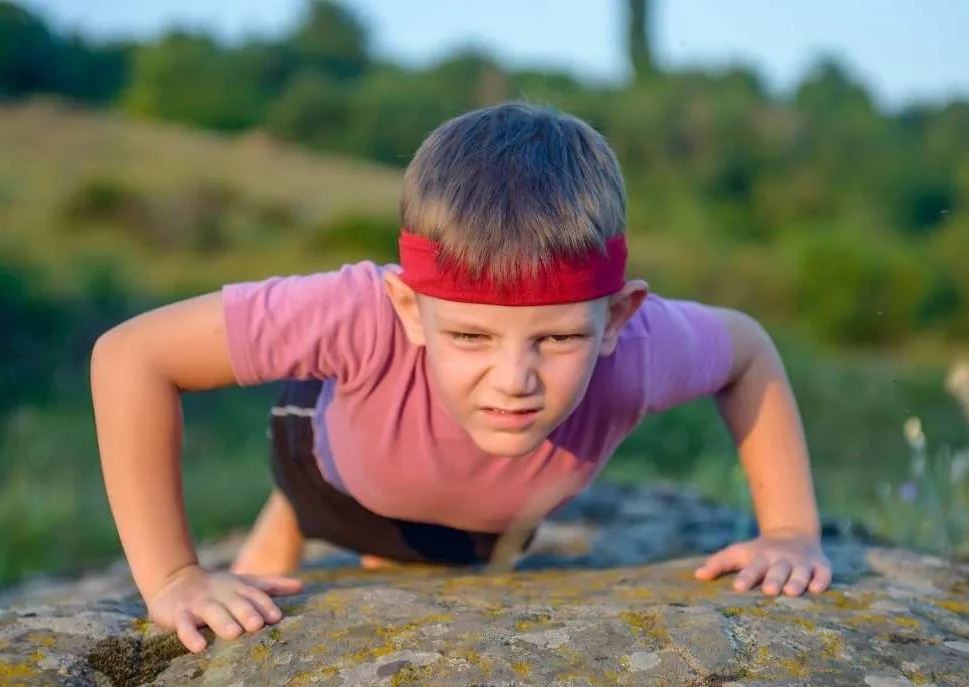
1. Push-ups
Two or three sets, stopping a few reps before failure. If full push-ups aren't there yet, hands elevated on a couch or a stair works perfectly — that's a regression, not a failure.
This is the foundation for shot power and for holding position through contact. Upper-body pushing strength is also the thing most young lacrosse players have the least of, because nothing in the sport builds it naturally.
2. Bodyweight squats and lunges
Two or three sets of each. Slow on the way down, controlled at the bottom, no bouncing.
Legs are dodging. Legs are riding. Legs are what's left in the fourth quarter when everyone else is walking. If a player only does one thing from this list, it should be this.
Watch the knees on lunges — they should track over the toes, not collapse inward. That's the single most useful coaching cue a parent can give.
3. Planks
Thirty to sixty seconds, two or three times.
Shot speed does not come from arms. It comes from the rotation of the torso and the ability to transfer force from the ground through the hips into the stick. That transfer requires a core that doesn't leak energy. A plank is the cheapest way to build it.
If sixty seconds is easy, don't go to three minutes — add a harder variation instead. Long planks stop training much of anything.
4. Sprints
Short and fast. Ten to twenty yards, six to ten reps, with full rest between.
This is the one people get wrong. Lacrosse is a sprint sport played in repeated short bursts, and distance running does not prepare a player for it. A kid who jogs two miles is training a system the game barely uses.
Full rest matters. If the sprints are getting slower, the workout is over. Quality is the whole point.
A hallway, a driveway, a gym, a field in forty-degree weather — anywhere works.
5. Jump rope or line hops
Two or three minutes total, broken into short bursts.
Quick feet win ground balls, win one-on-ones, and keep a defender in front of a dodger. Jump rope is also the most fun thing on this list, which matters more than it sounds — a routine a kid enjoys is a routine that survives February.
How to actually make it stick
Keep it to twenty minutes. The most common failure is a parent building an ambitious program that lasts nine days. Twenty minutes twice a week for twelve weeks beats an hour-long session that gets abandoned in week two. Consistency is the entire variable.
Form before load, always. For young players — and especially before and during a growth spurt — technique and movement quality matter far more than how much work gets done. There is no reason to rush a young athlete into heavy weight. The body will be ready for that later, and the kids who got strong on bodyweight first tend to do better when it arrives.
Let it be play. Make the sprints a race. Time the planks and chase the record. Let them pick the order. A twelve-year-old who thinks of this as training will quit. One who thinks of it as a competition with their sibling will do it all winter.
Pair it with the stick work, don't replace it. Strength twice a week, wall ball most days. They do different jobs and the combination is what produces the March difference.
Talk to a professional first. We're an equipment company, not a medical one. Before starting any new training routine — especially with a young or growing athlete, or one with any injury history — run it past their doctor or a qualified strength coach. Anything beyond these basics should absolutely be built by someone who can see the player in person.
What this adds up to
Twelve weeks of winter. Twice a week. Twenty minutes.
That's roughly eight hours of work. Eight hours is nothing — it's one weekend tournament — and it's enough to change how a thirteen-year-old moves, because at that age the floor is low and the response is fast.
Their teammates are doing none of it. That's not a knock on those families. It's just true: almost nobody does the boring, invisible, no-equipment version of the work in January.
Pair it with the stick work and February becomes a very good month. March takes care of itself.
Keep the reps going: rebounders for wall ball when there's no wall, goals for shooting at home, and enough balls that collecting them isn't the workout.